Horn
After I got home, I put some oil in the horn compressor and tested it. Worked fine, so I thought that it was a simple and quick fix. I didn't even have to take the compressor apart and clean it.
The next time I drove the car, the horn didn't work. Aargh! At least this time I was just trying to get someone's attention as opposed to needing it as a warning to another motorist.
So I got out the volt meter and found that there wasn't any power getting to the horn. I got out the owner's manual and spent a few minutes blowing up the wiring diagram big enough that I can follow it without using a microscope. I also copied the legend and relay information. Now I was ready to find the problem. The fuse was fine. Jumping power directly to the horn made it work, so I could forget needing to do anything up front. Closed the hood (or is it the trunk since the engine is in back?). I swapped relays with an identical one known to work and that didn't solve the problem. Then I checked to see if the horn button was grounding the lead at the relay. No ground, so the problem now moved to the driver's side of the car.
I removed the steering wheel and then found out that the horn button (unlike the 330), just pulls off. Re-installed the steering wheel. Grounding that wire didn't blow the horn, so I played with the wiring bundle below the steering wheel. Grounding the wire there did blow the horn, so the problem had to be in the slip ring and brush that allows the wire connection to work as the wheel is turned. In fact, turning the wheel about 1/2 turn to the left or 1/3 turn to the right enables the horn to work. So that's why it probably worked when I first oiled the compressor. I imagine that the wheel wasn't straight and the slip ring and brush were in contact. However, having to turn the wheel in order to blow the horn isn't too desirable in most circumstances, so I continued working on the problem.
To remove the steering wheel hub requires a special tool that has four tabs that fit into slots in the nut.
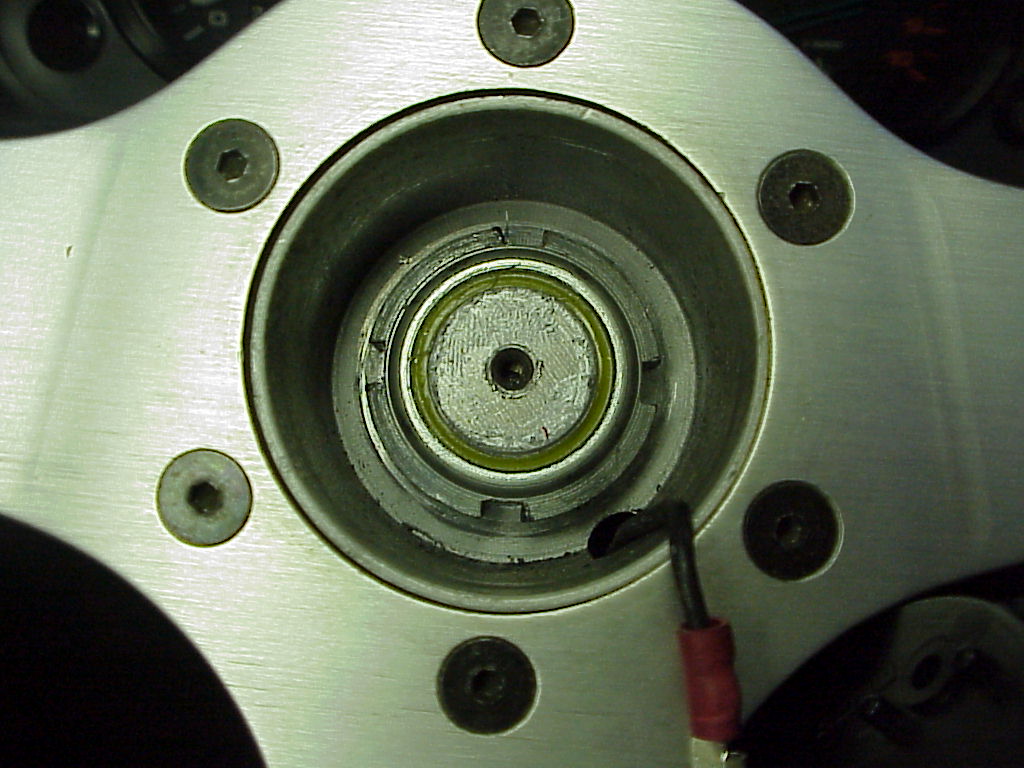
As I didn't have such a tool, I measured the nut diameter and bought a 1 3/16" socket. Then I located where the tabs needed to be on the socket and removed the material in between them.
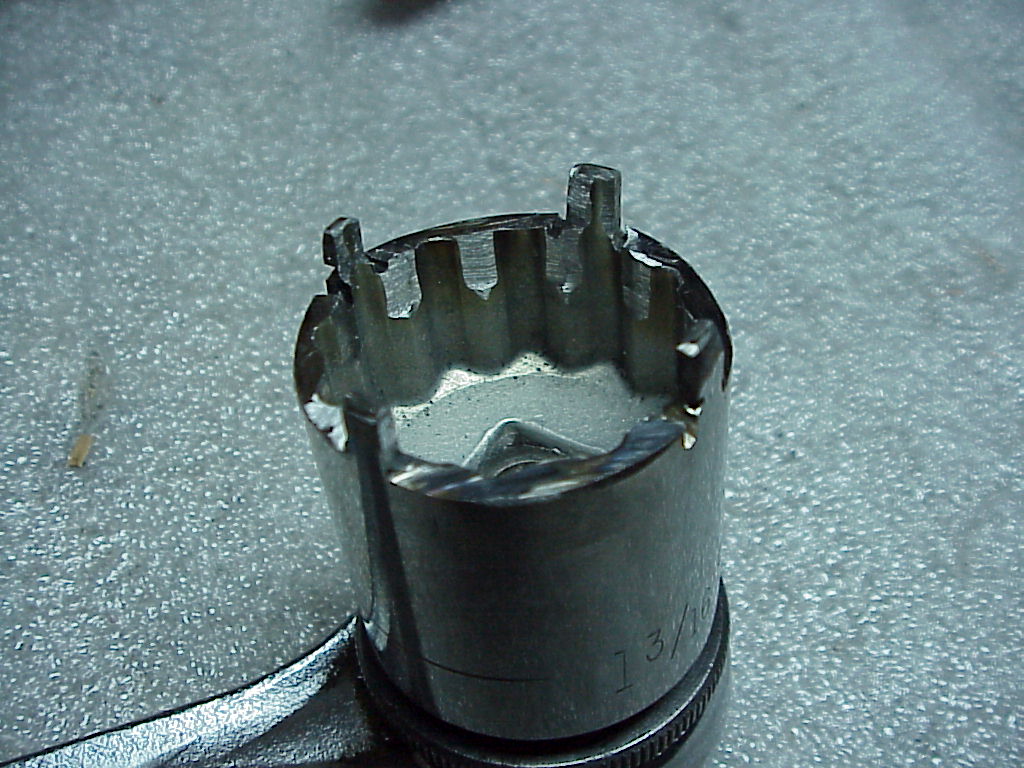
Once the tool was made, I was able to remove the nut and hub.
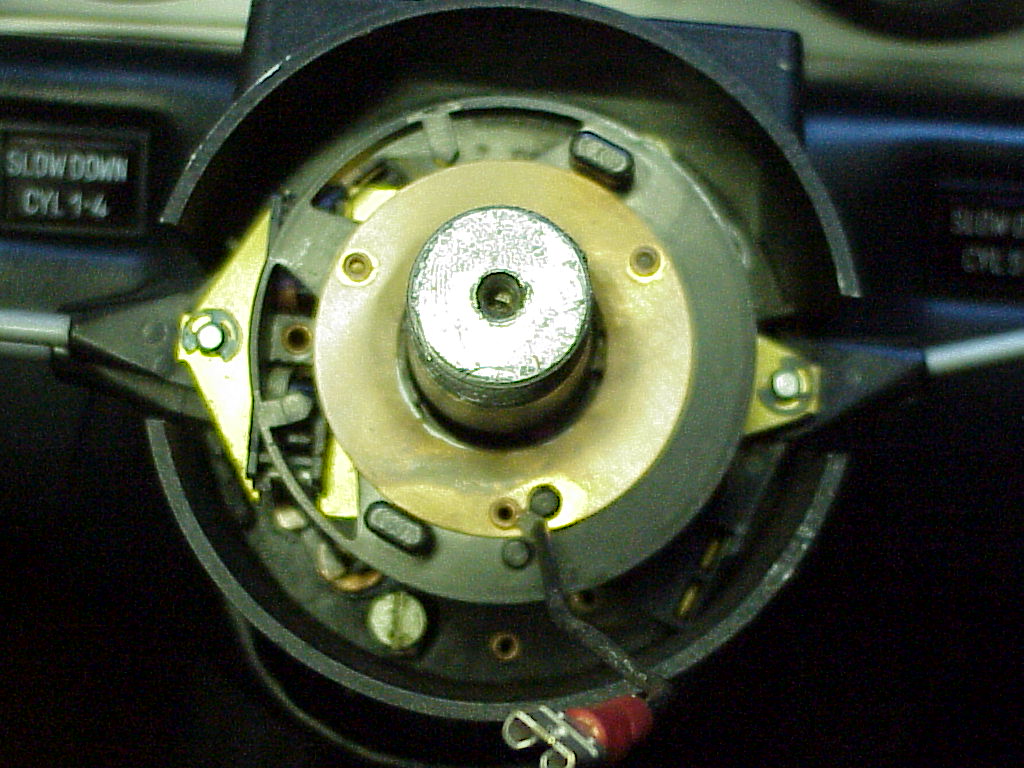
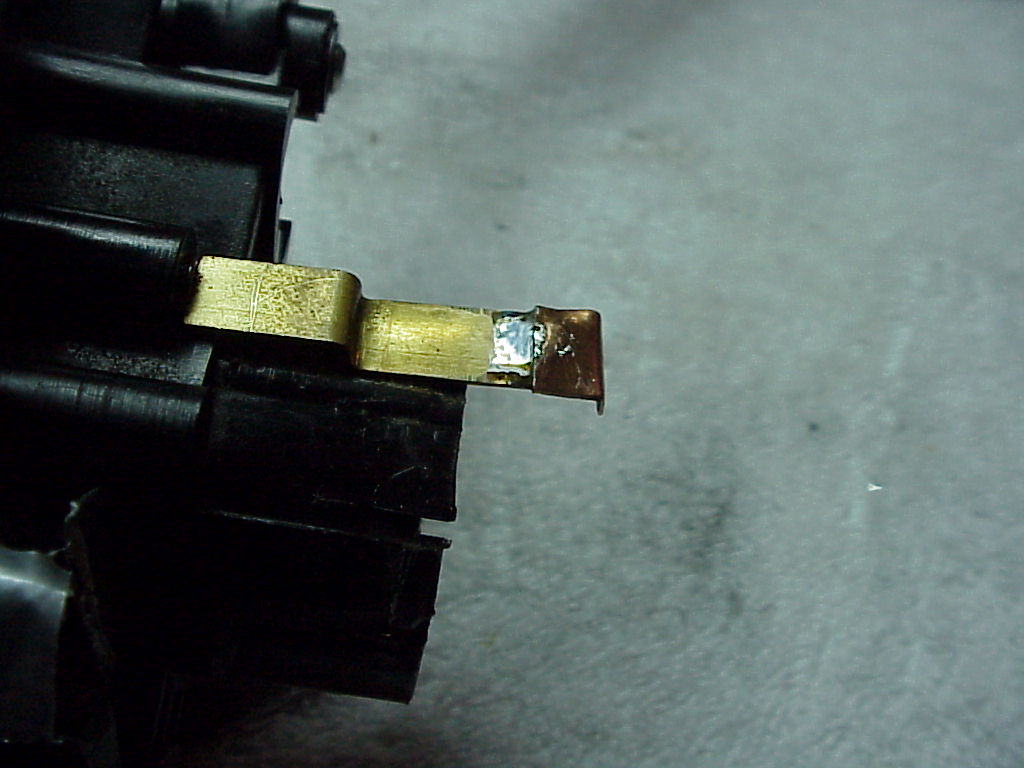
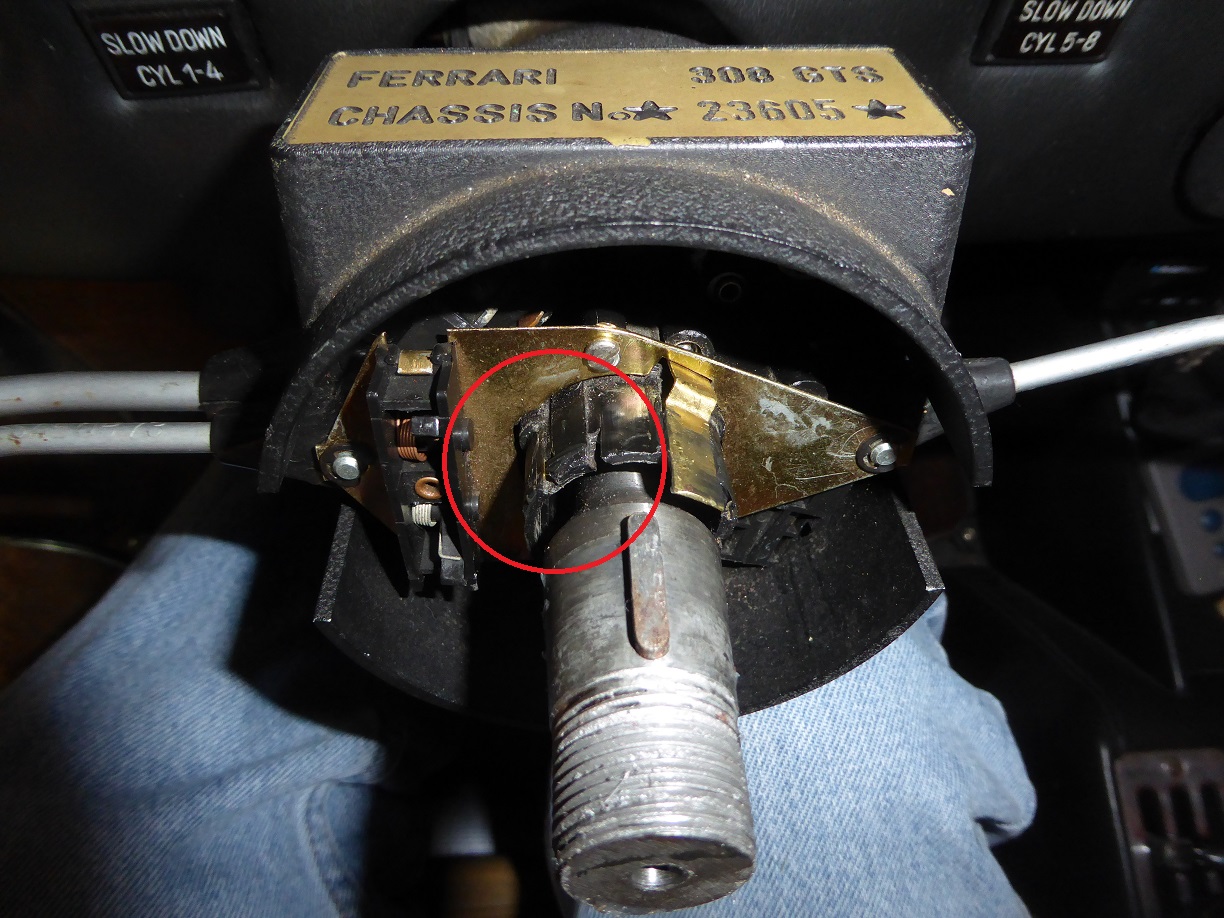
As usual, things don't go as smoothly as one would want. I finally figured out that there was a spring loaded piece of brass that is supposed to touch the round brass ring in the picture above. The problem was that it was so worn that it was bottoming on the plastic part of the ring.
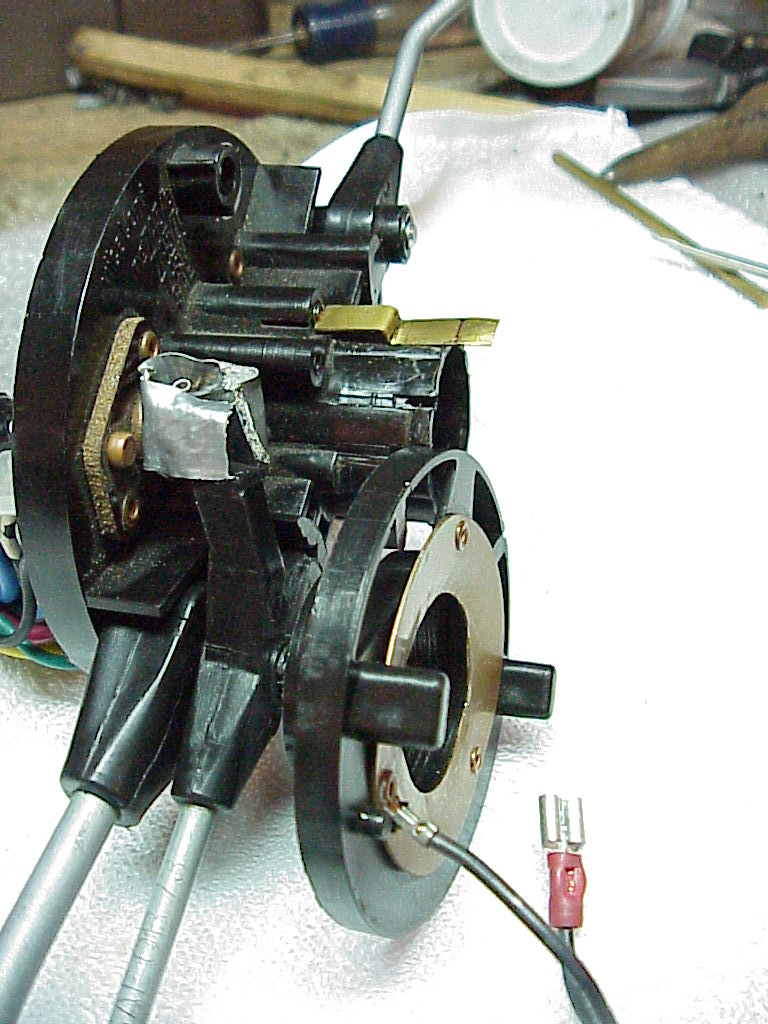
You can see the bend in the brass contact. That's where it was touching the plastic ring. After looking at the mechanics of the contact, I decided to not make and replace the whole thing. So I made a piece to solder on the end to add the length that has been worn away. I didn't have any appropriate thickness of brass, but had some copper. I cut, bent and soldered on an extension. I made it L-shaped so there would be better contact with the brass ring.
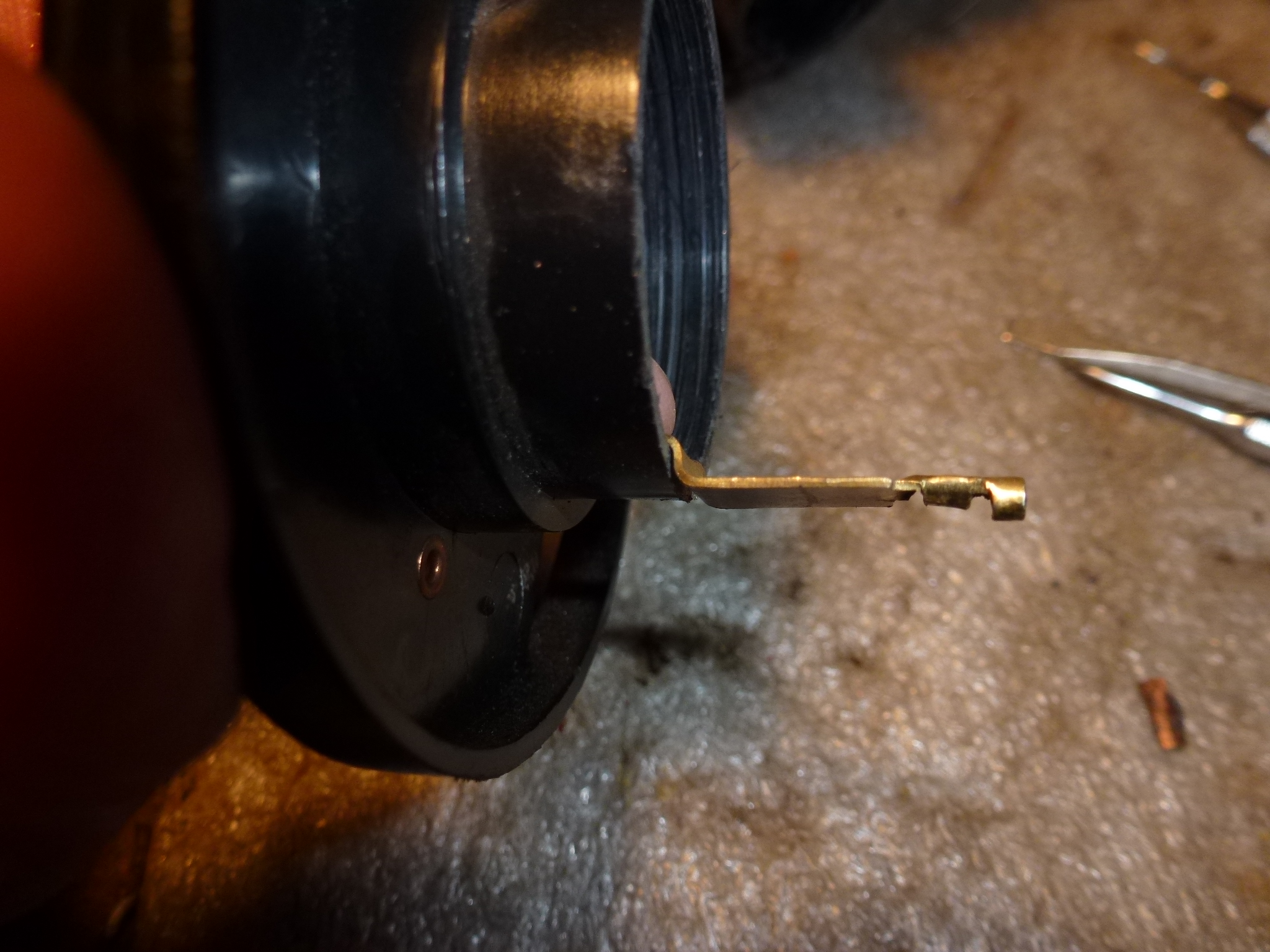
Now in the process of taking this all apart, one had to remove the metal piece with the C-clips that hold the various stalks in place. I should have put the C-clips back, but I didn't. Of course, the wiper stalk came apart with springs, ball bearing and the contact flying in all directions. I was able to find them. Then a little tiny piece came out from under the headlight/turn signal stalks side. So I had to take that side apart too. The design is almost identical to the stalk system on my 330 GT, so I had already figured out the best way to put everything back together. Click here for more detail. The special tool that I used to put the ball bearings back in place on the 330 didn't work on the 308 because the center part stuck up too far. So I used a piece of aluminum that I put a detent into using a center punch. This kept the ball bearing on top of the spring while you pushed it into the recess and then pushed the stalk down on the pivot.
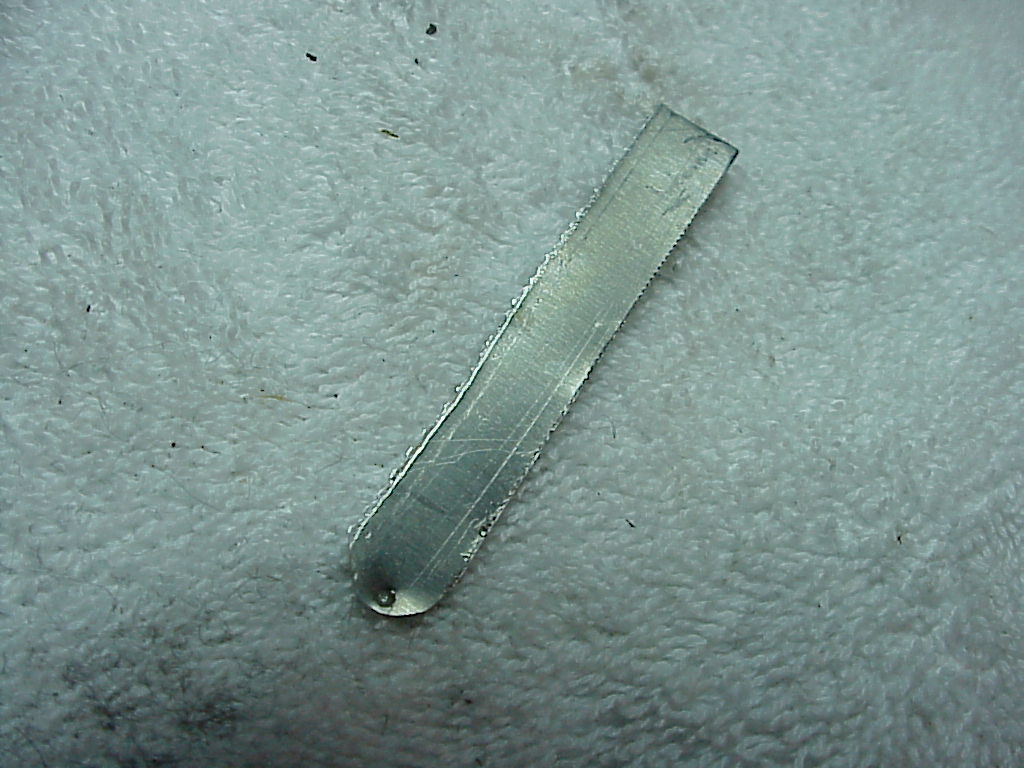
I finally got everything back together and the ohm meter confirmed that I was getting good contact completely when the ring was turned. So I buttoned up everything. I had removed the horn fuse so I wouldn't blow it by accidentally grounding the horn lead. This just kept the horn from blowing, but the relay would still click. As I was tightening the special nut, I could hear the relay clicking even though I wasn't touching the horn wire. That was a bad sound. I reconnected the fuse and found that the horn would blow simply from turning the steering wheel. I ended up removing the wheel and hub again.
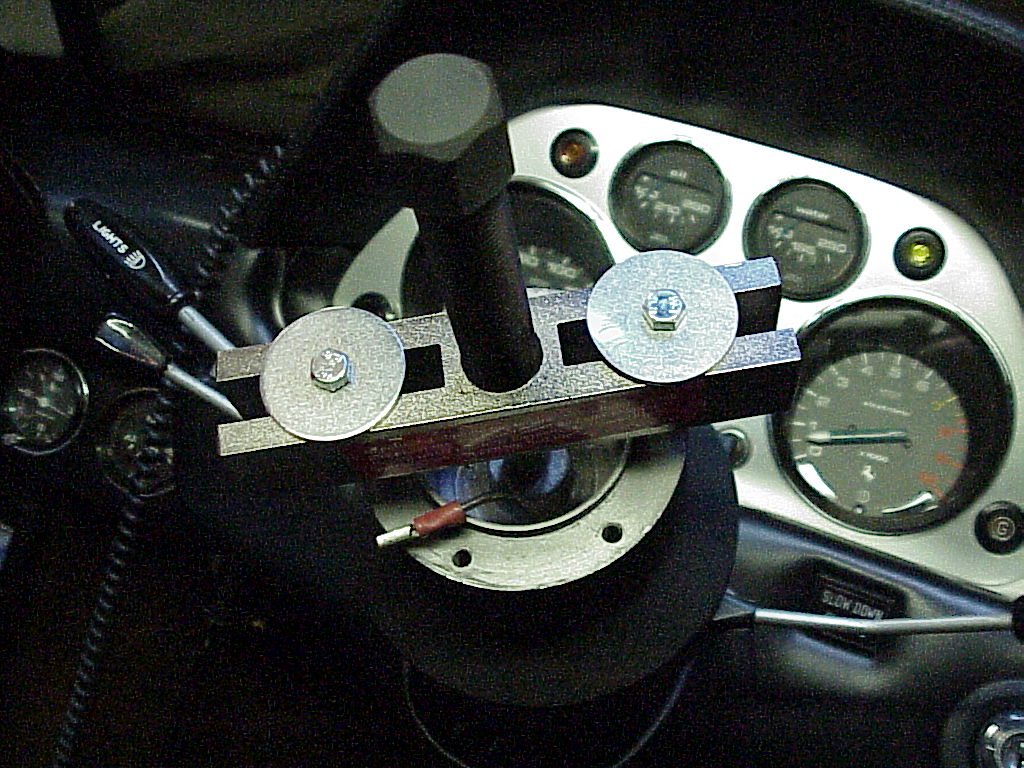
Once apart, I found that I had forgotten to align the plastic ring with the holes in the back of the hub. Once I put that right, the horn wire no longer touched the hub as you turned the wheel. So finally I was done and the horn works when it should and not when it shouldn't.
Skip forward a few years. I went to a local cars and coffee meet (Exotics at Redmond Town Center) and on the way home, the horn started to blow whenever I turned a corner. Luckily, I was only a mile or so from home when this started. However, I'm sure that the car ahead of me wondered why the Ferrari behind him was blowing his horn for no reason. I just disconnected the horn the next time I needed to drive the car.
However, I ended up having to drive the 308 on a three day trip as the 330 had an issue. I tried to fix it correctly that evening, but couldn't get the Allen flat head screws off to remove the steering wheel. By this time, the horn button had stopped working, so I wired up a temporary switch for the trip. I presume that the extension that I had soldered on had come loose, originally shorting and blowing the horn as the steering wheel was flexed, and finally no longer working at all. I had to order a 3mm Allen head socket, that hopefully will allow the screws to be removed. The other ideas from Ferrari Chat were to shock each screw with several blows from a pin punch and to use heat from a soldering iron to loosen them up. I tried drilling out one, but just ended up breaking the drill bit, so had to give up.
Well, the socket came and I managed to remove only one screw intact. At least that allowed me to measure it (5mm x 12mm black oxide flat head Allen screw) to order new ones. I drilled off the top of the other ones and the steering wheel was off. A small vise grip pliers were able to grab on the remnants of the screws and they all backed out easily. After removing the column switch assembly, I couldn't figure out how to remove the ring the connects to the horn button. I had figured it out 9 years ago, as I had a picture of it apart. Another picture showed three clips holding it on, but no way to release them. I ended up just turning and pulling on the ring and it slowly came off.
Looking at everything, I could not see any problems that would cause the horn to blow during a corner. I had already decided to make a new contact. As I was removing the old one, the L part of the soldered on piece came off. In in hind sight, perhaps that had partially worn through and was sticking out enough to contact the steering column at times. After measuring the thickness of the contact (.025"), I ordered some brass strips from McMaster-Carr. Once the stock arrived, I made a replacement contact that was about 1/4" longer. Given my age, this should be a life-time fix.
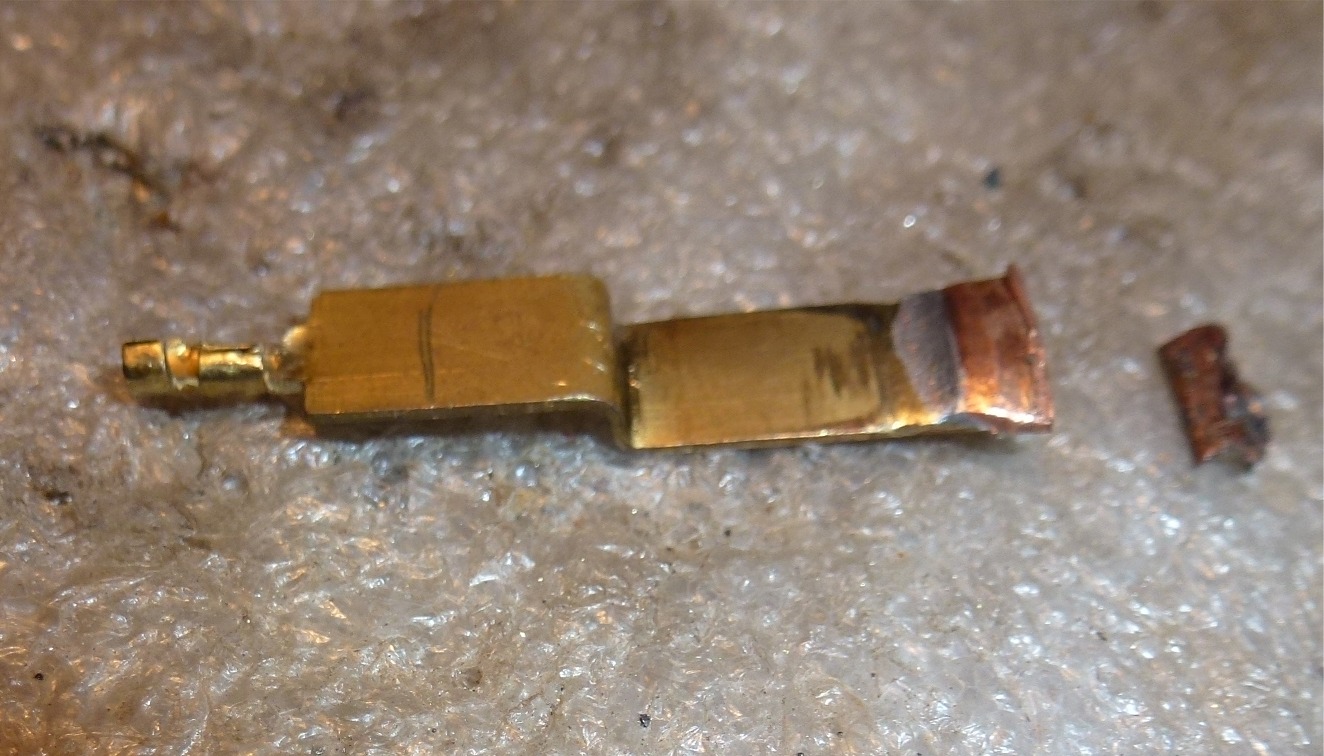
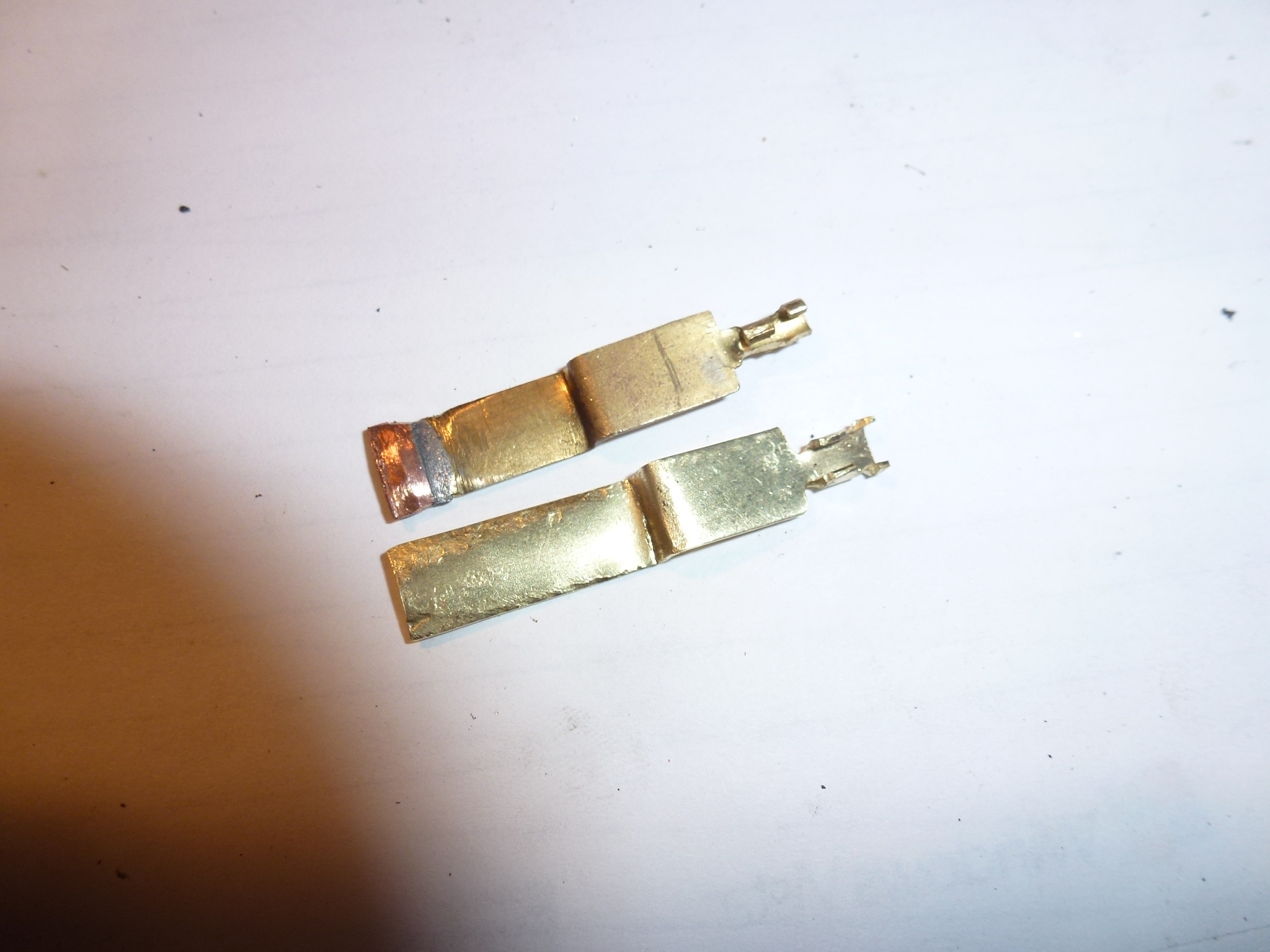
The jog in the middle turns out to be quite critical and mine was a bit too wide, so I had to play to get it to work right with the spring.
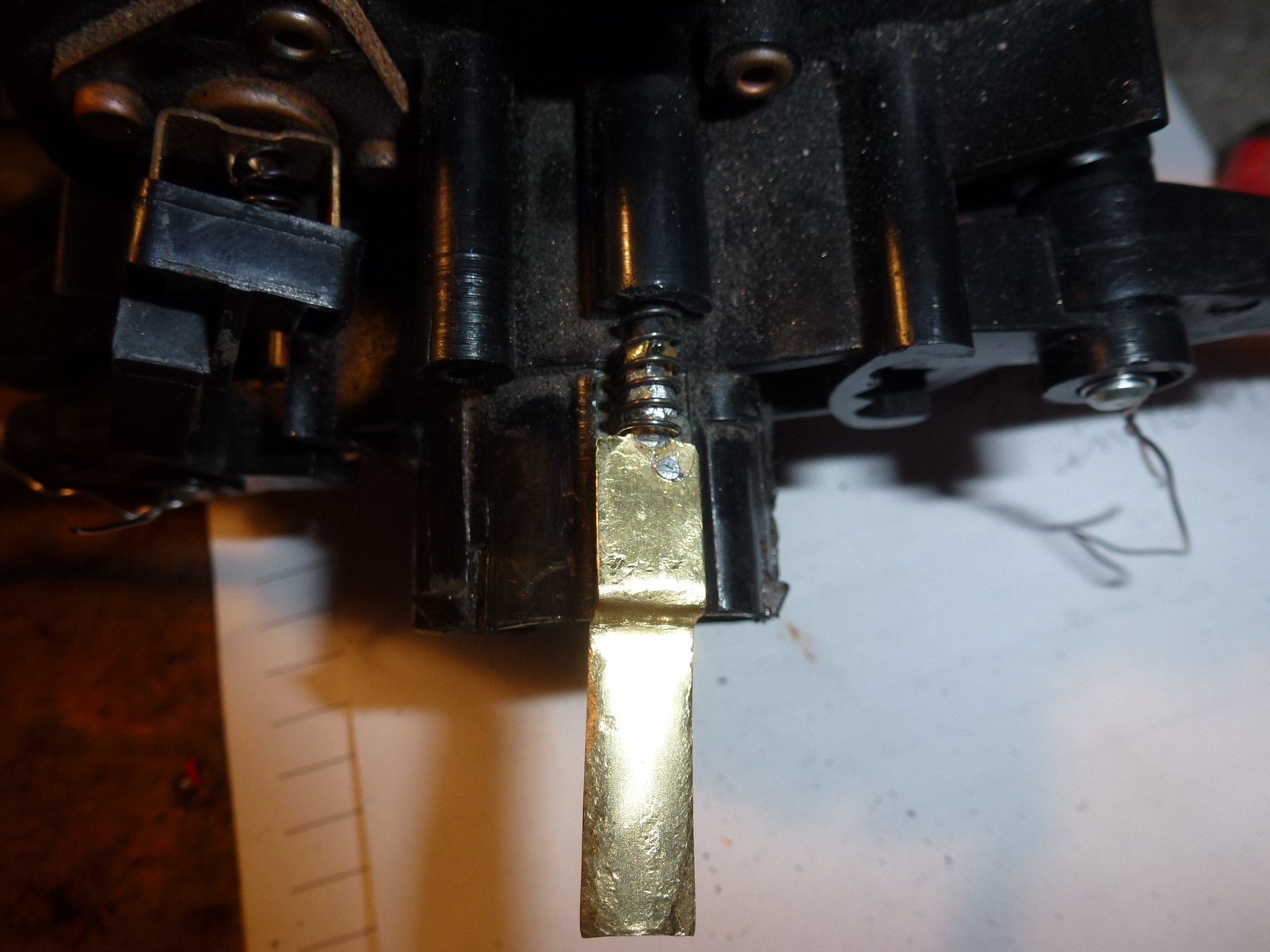
Once I got it sliding properly, I used some copper paste that Verell supplied when he put a new stalk end for the headlights on my 330. Hopefully, this will let this contact rub without wearing as quickly. I also put some on the contacts for the headlights, turn signals and wiper stalks. I did a ohm test on the bench to make sure that the contact was working correctly. Final assembly put the interior back together, using new screws for the steering wheel. The last set of tests made sure that the horn would not blow by torqueing the wheel and that it would blow when pressed as the steering wheel was spun 360 degrees.
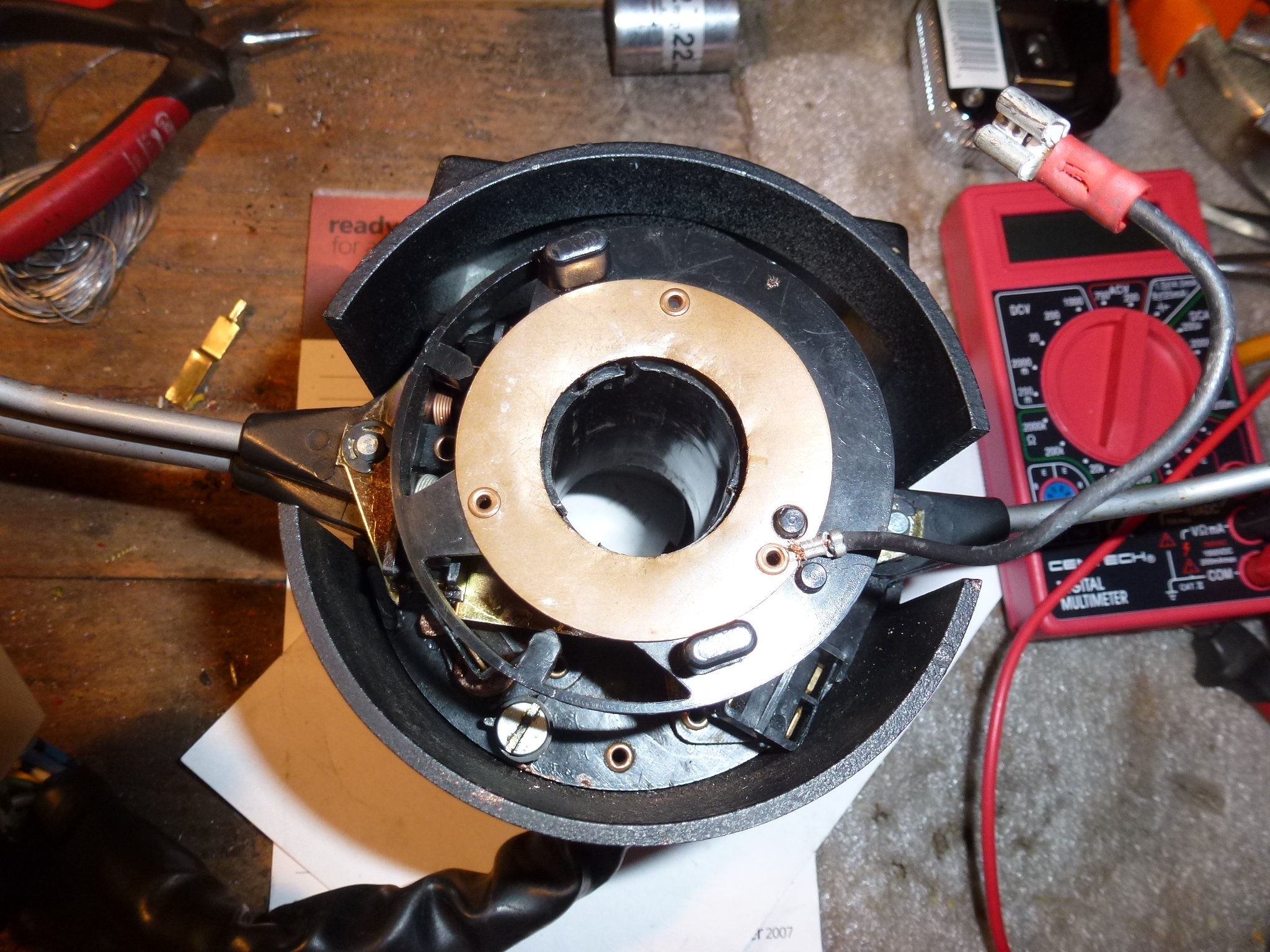
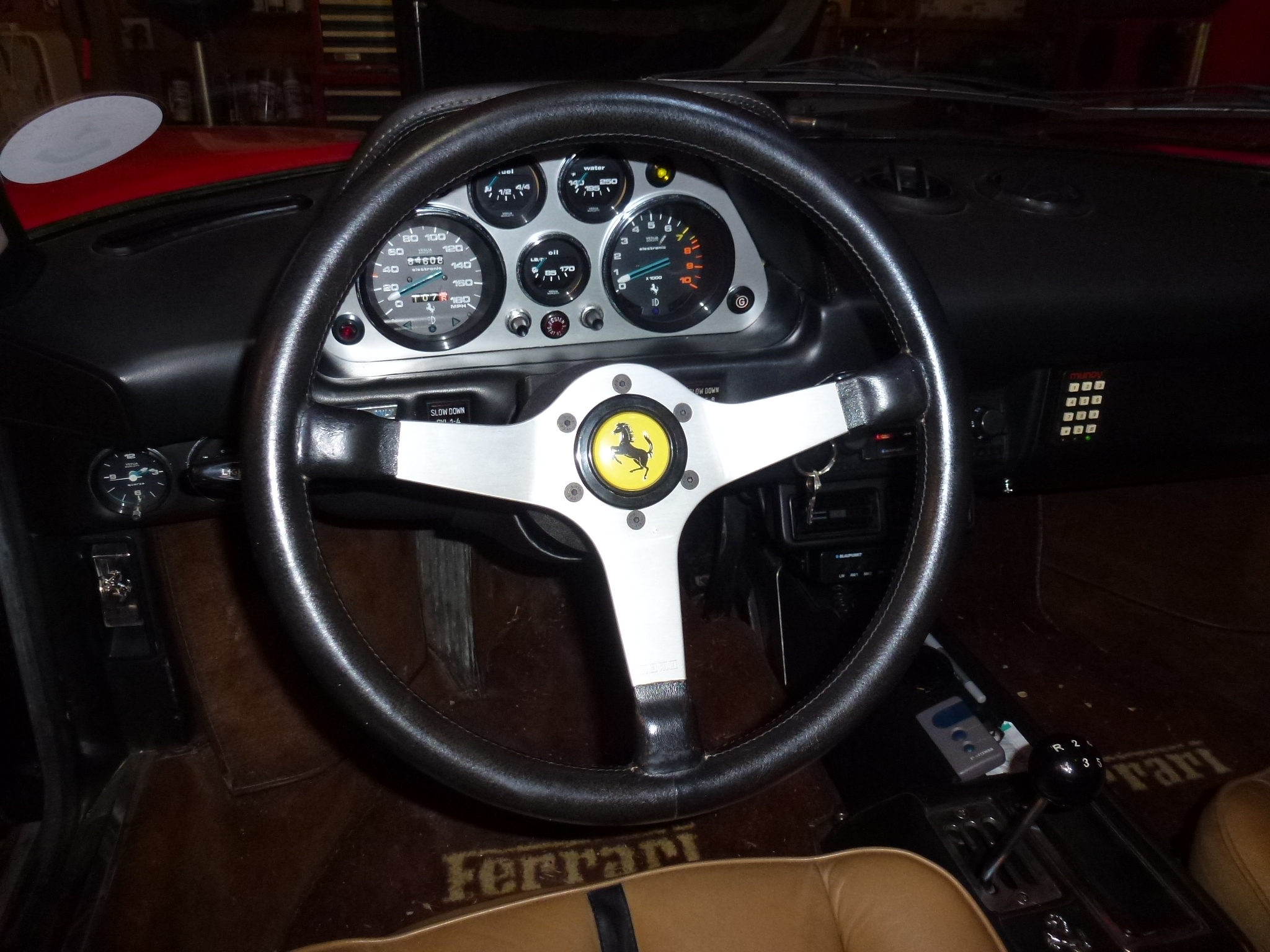
Well, fast forward a few more years. It's now 2021 and car events are opening up as people are getting vaccinated. Some annoying things started bothering me on the 308 now that I'm driving it a more. They all are steering column related. First, the horn blows at random in a turn when the steering wheel is turned about 90°. Second, the turn signals no longer self cancel. And last, there is a squeaky rubbing noise as I turn the steering wheel. So it's back to taking off the steering wheel and hub to see that is going on.
Problem one had been temporarily solved by disconnecting the horn at the compressor. Not a great solution, but better than having people get mad as they think you are blowing your horn at them when they are doing nothing wrong.
Problem two was simple, just keep your hand on the turn signal and remember to turn it off. Easier said than done as I found myself noticing the dim turn signal indicator blinking sometimes a mile after the last turn.
Problem 3, just ignore the noise and don't have a passenger who asked why a Ferrari would have a squeaky steering wheel.
Today was the day to work on all of these issues. First, remove the horn button, steering wheel and hub as described above. I did go back and refresh my memory by reading this page and looking at the pictures. At 70+, I find I use this restoration site to remember what I did several years ago.
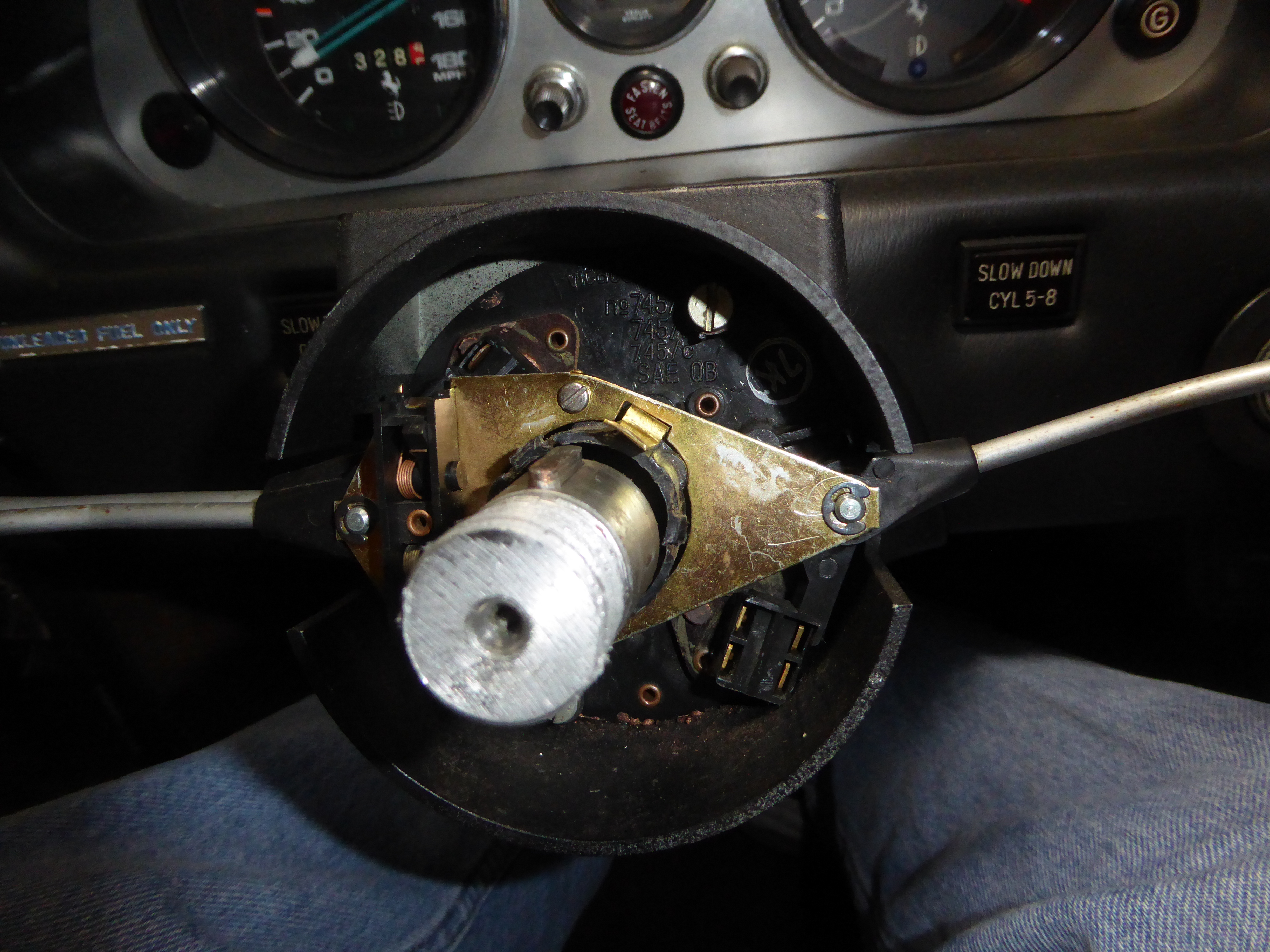
First I looked at the self canceling issue. If I held the plastic ring down tight, everything works correctly. As I was looking at why this wasn't tight, I noticed that there are three tabs that fit over a lip on the inside that are supposed to keep everything where it belongs. However, one tab was missing (left picture), another worn (middle picture) with only one good one (right picture).
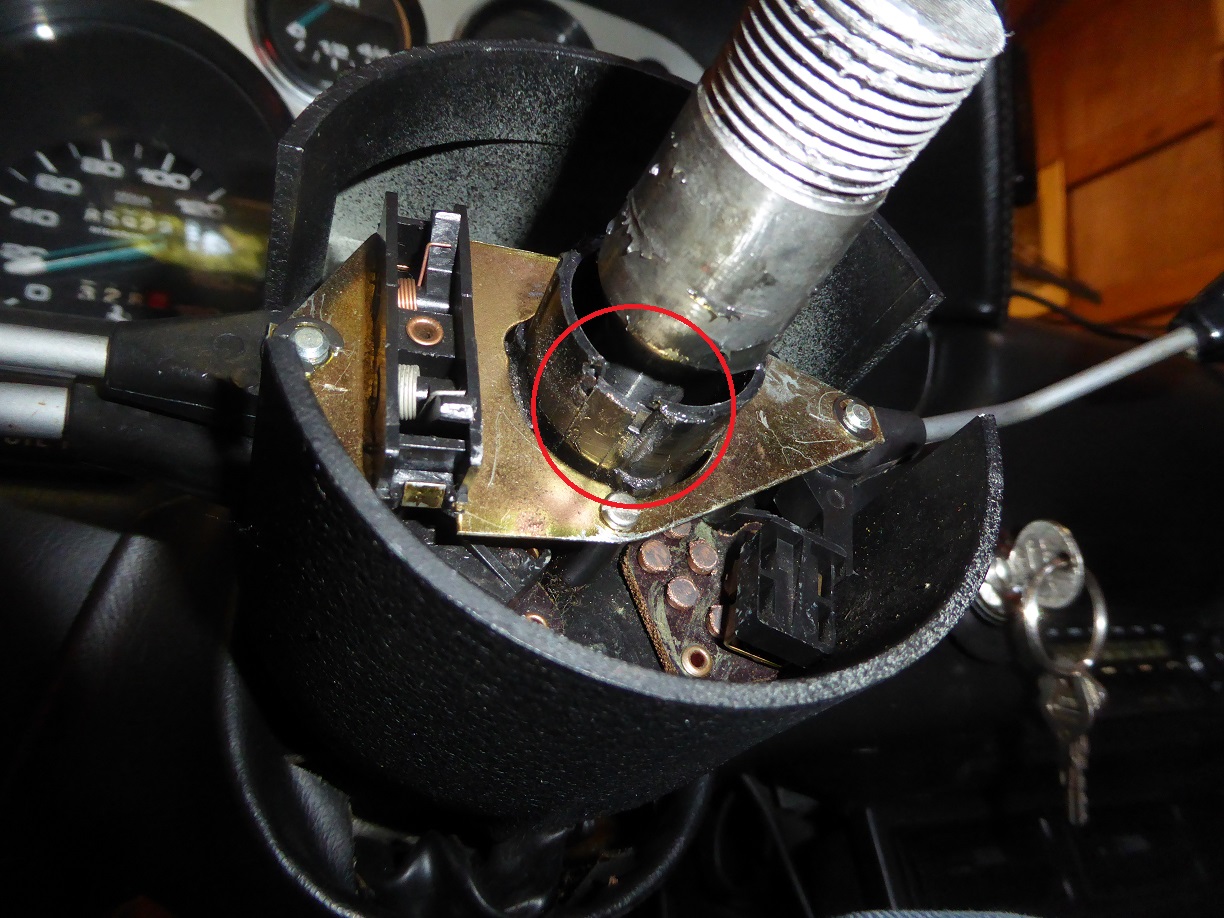
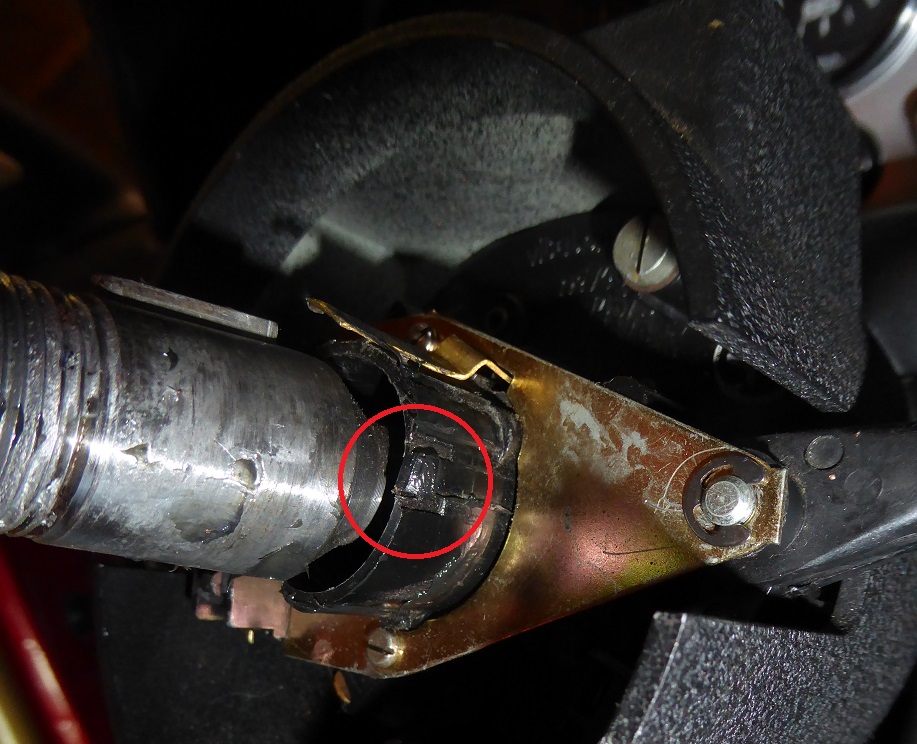
This allowed the ring to not stay close enough the trip the turn signal levers. This part is a single piece that also has all of the contacts, etc. So short of finding a good used stalk assembly, there was no fixing the tabs. After thinking for a while, I thought of having the hub hold down this ring once it was in place. Notice the two tabs that stick up. These fit into holes in the hub and make the ring turn as the hub turns. I thought that I could pad the holes somehow so the ring would be forced in place. The problem was how much padding would be needed and what to use. Measuring looked difficult as the hub covers what you need to measure when it is in place. I figured that using some clay like substance that would squish would get me close. I didn't have anything, so I went back to my neighbor's shop. He did have some Play-Doh, but suggested that it might be easier to use some gasket stock, paper or cardboard between the brass ring and hub to figure out the spacing. A light bulb went off and I said, why not just use some rubber washers. That would also isolate the ring from the hub because if they touch, the horn blows. So I went back to my shop to make it work.
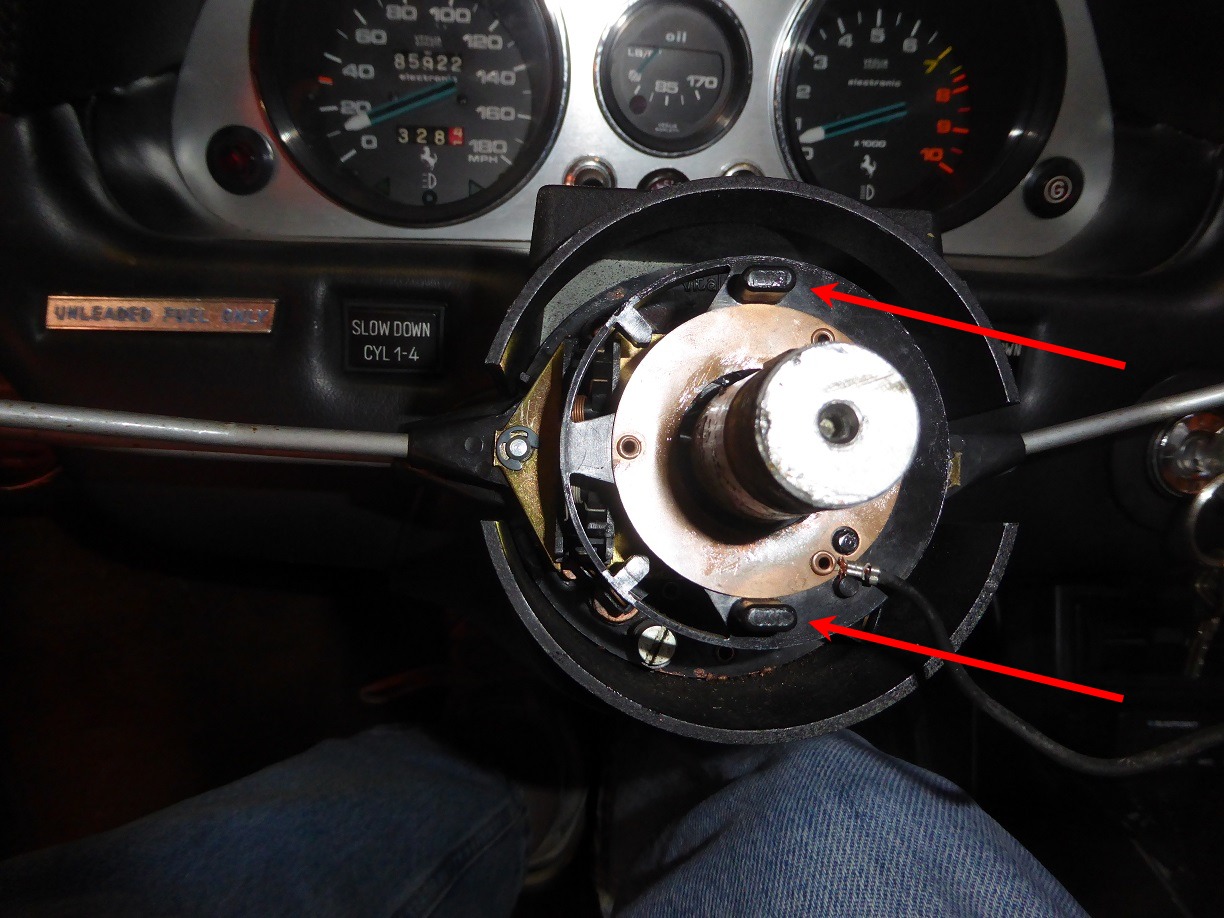
I started by cutting some cardboard into the washers I needed, figuring that I could see how much the cardboard squished when the hub was tight. Even one layer of cardboard was to much, so I cut a washer from some 1/16" sheet rubber I have. That wasn't enough, so made more. Ever try to use a hole saw on thin rubber? In the end, I just used the hole saw to lightly mark the rubber and scissors to cut them out. It ended up taking four layers, or about 1/4" thick. Here are the rubber washers covering the brass ring.
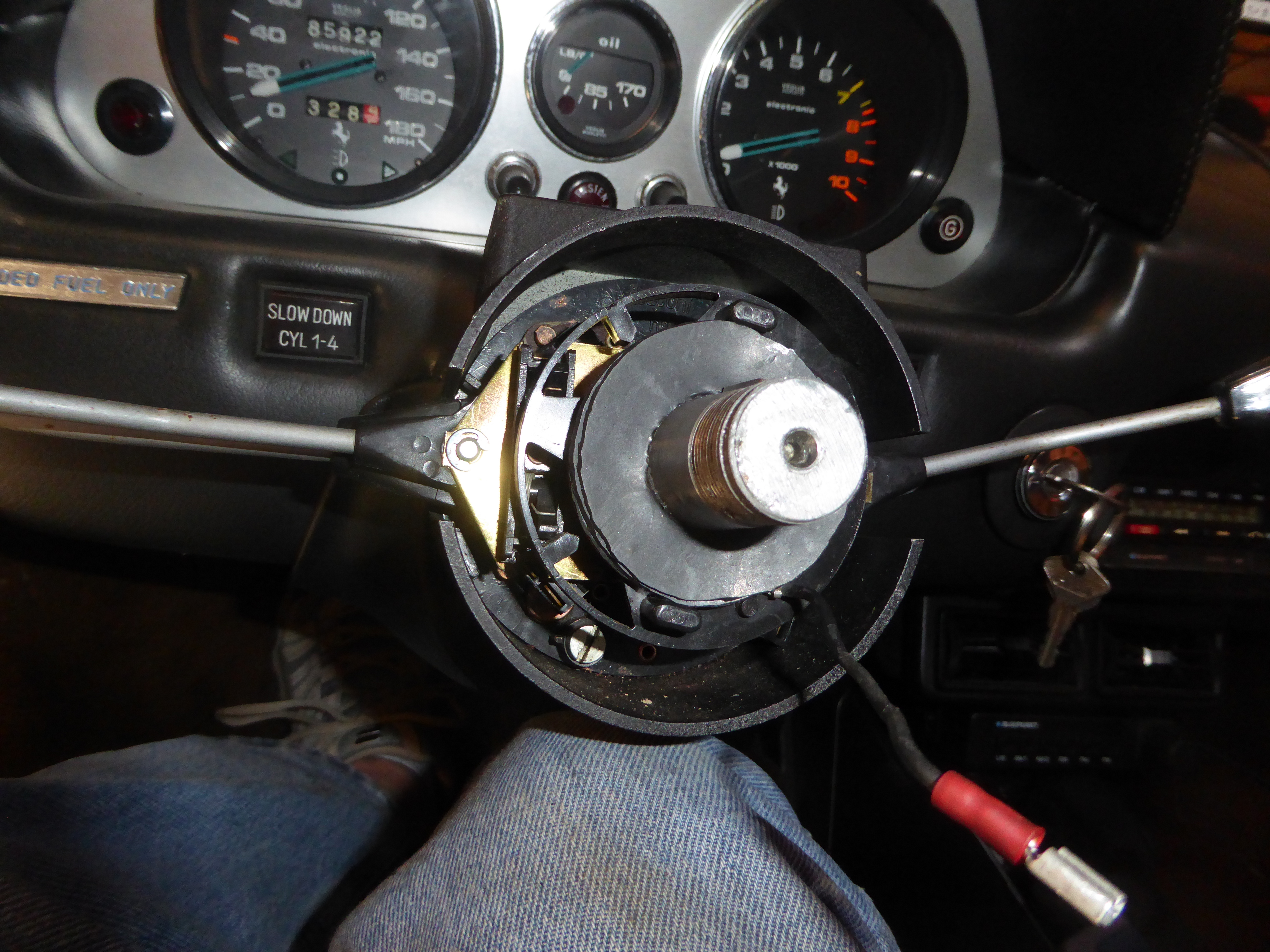
In the end, I think that the horn blowing randomly was that the brass ring could lift and touch the hub, thus blowing the horn. So two problems solved with a single solution.
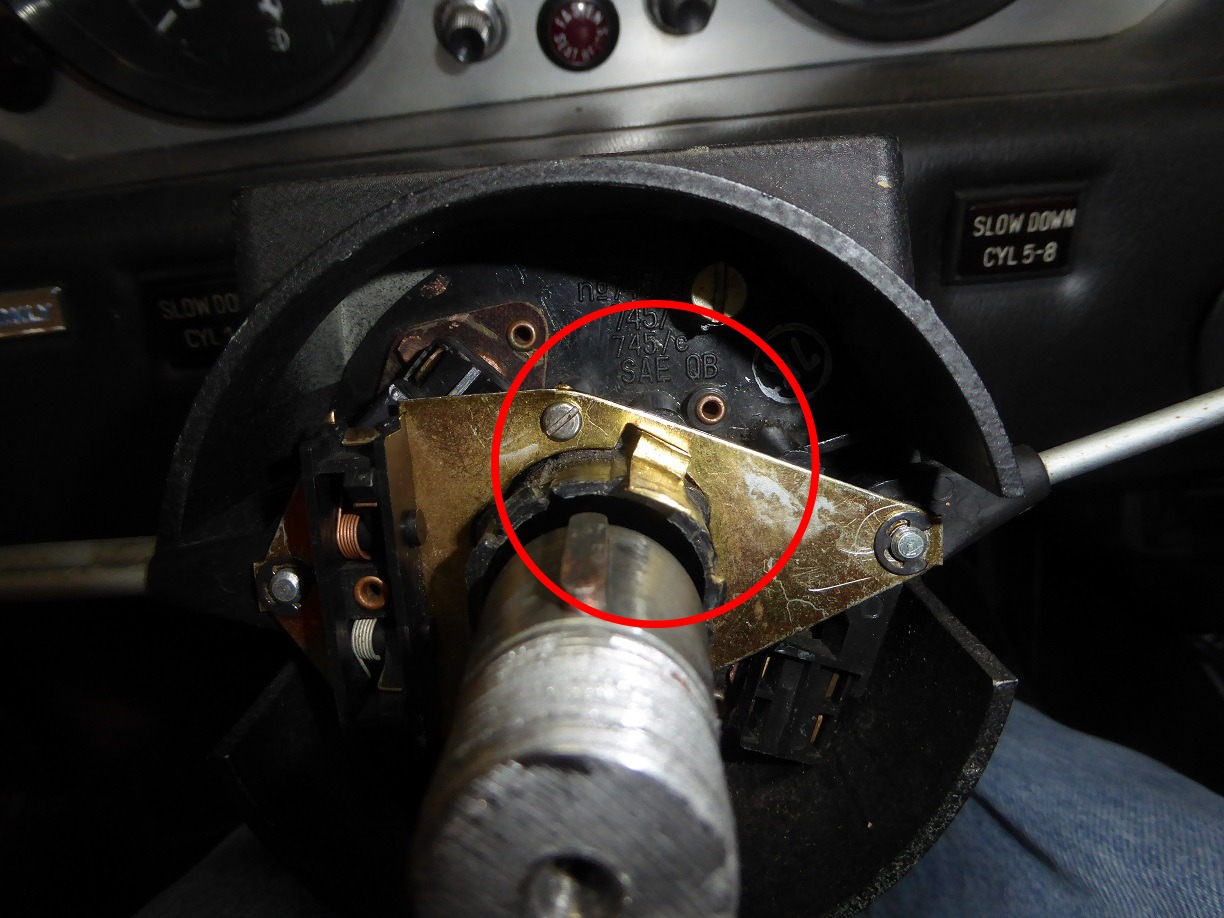
The squeaky noise ended up where the brass contact I had made before was rubbing on the inside of the plastic ring. As you can see in the left picture, it doesn't conform to the column as nicely as the original. I did do some bending, but also put a little grease on the inside of the ring where the arrow points.
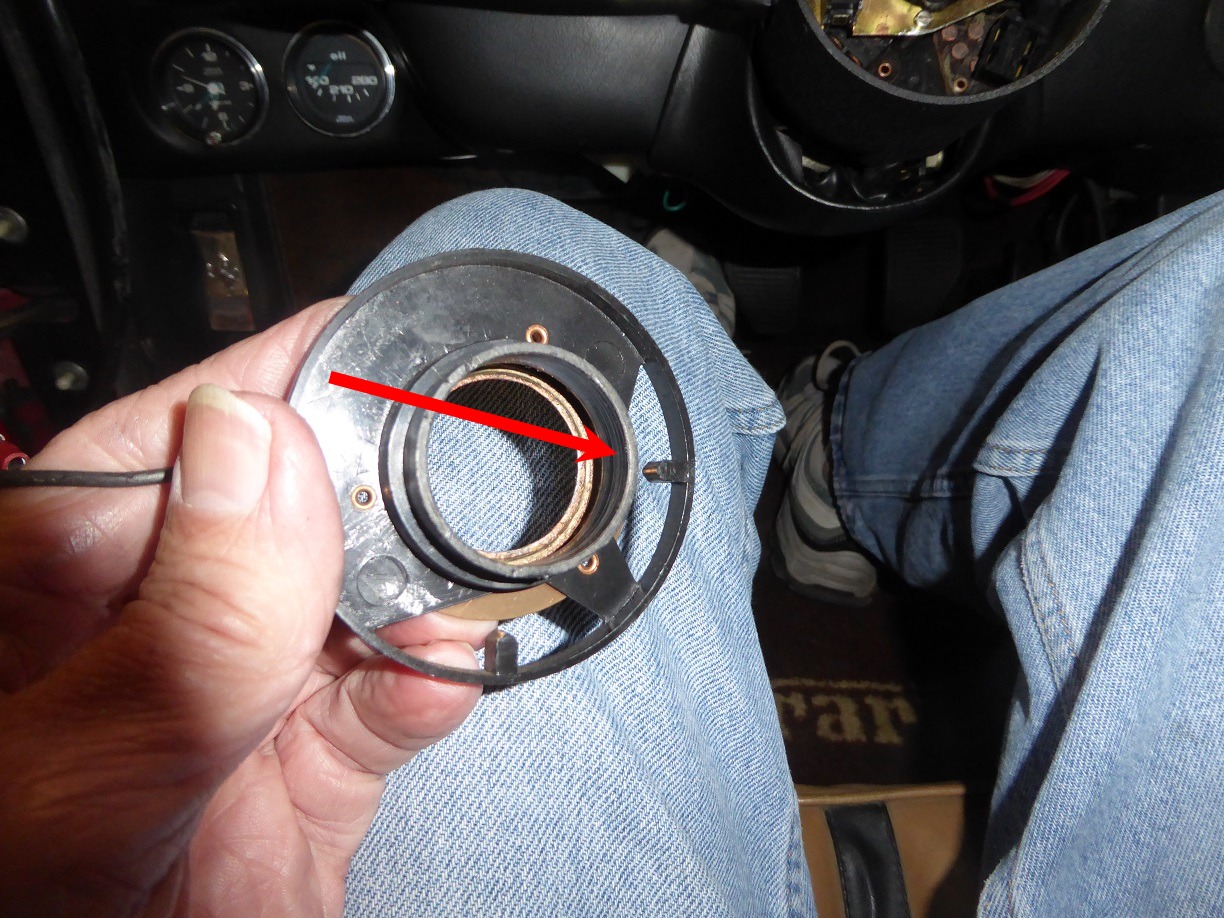
So everything is back together and fully tested at the car was on the lift allowing me to turn the steering wheel back and forth easily.
The last thing was to refinish the Allen flat head screws that hold the steering wheel on. I had to buy new ones when I took the wheel off years ago and used a black oxide kit then. However, they still ended up rusting. I looked at McMaster-Carr and found that I could get the proper sized screws in black oxide for about $20. Of course, there are 100 in the pack, so that's 16 cars worth (let me know if you need any). They wokbC!5413#cBKn't be here for a few days, so I bead blasted the old ones and painted them black to have them look good in the meantime.
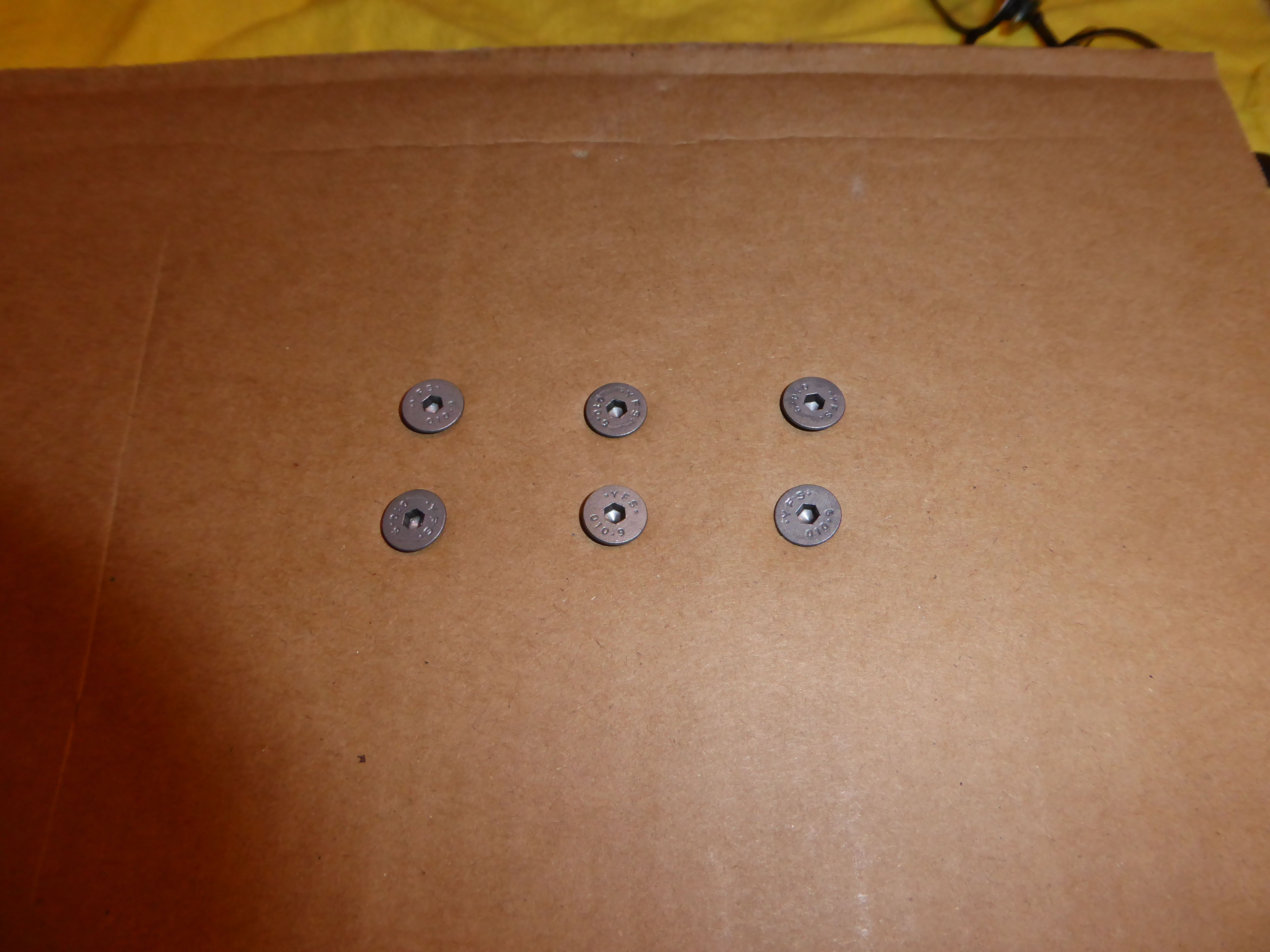
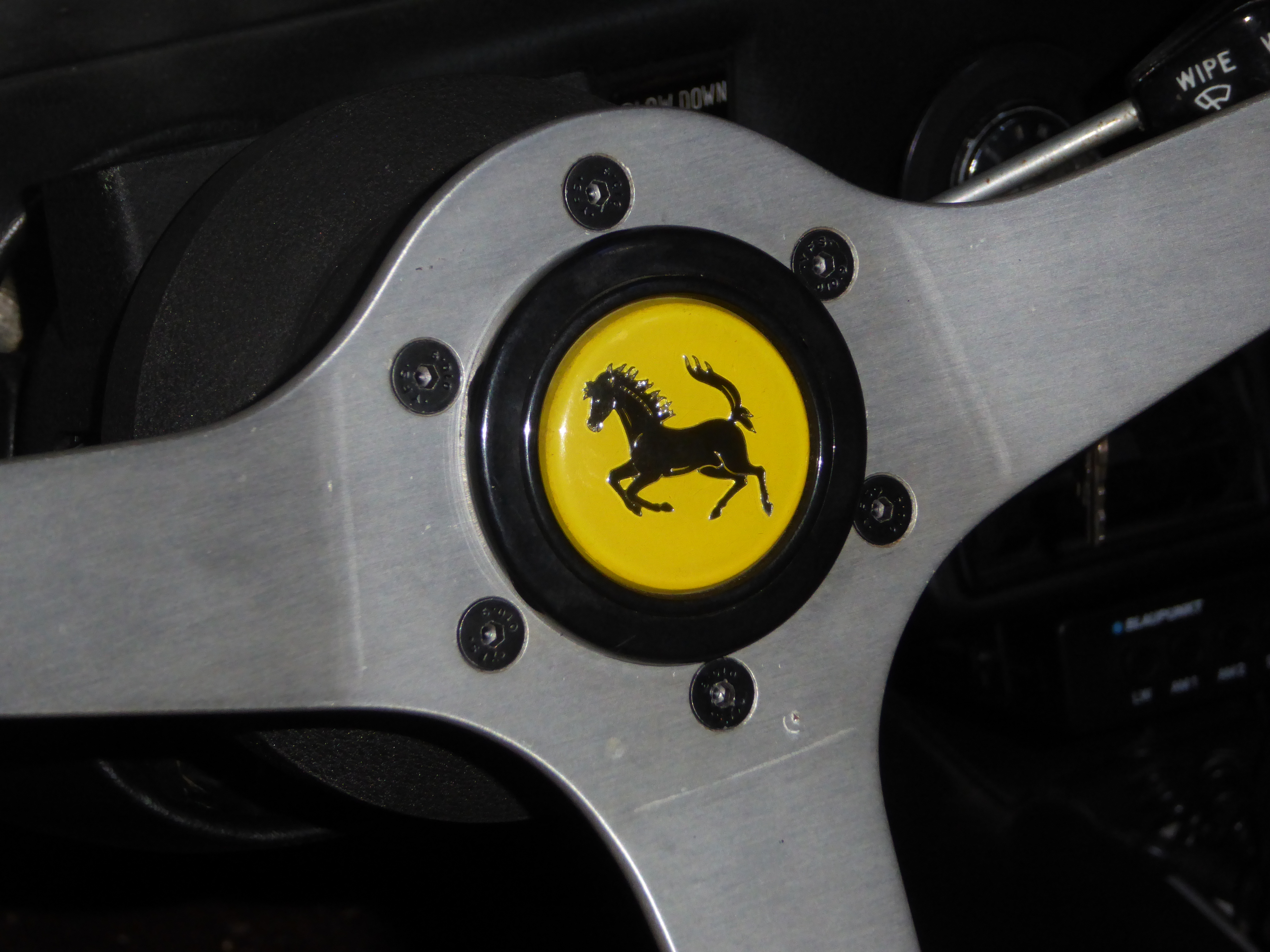
The good thing about all this work was that I didn't have to take off anything dealing with the stalks, so no flying ball bearings and springs.